Product identity
Manufacturer SKU, MPN, and model information
Use the manufacturer’s SKU, MPN, model identifier, or configuration code to match the exact equipment and variant.
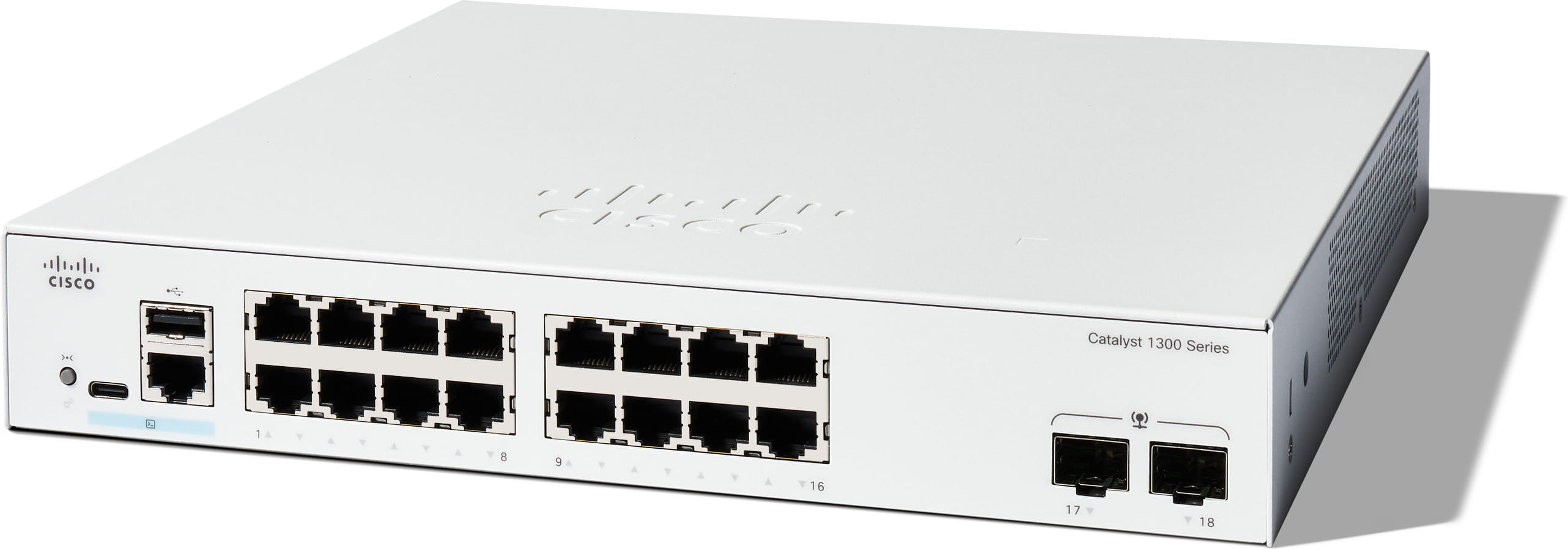
Cisco Catalyst C1300-16T-2G Managed Switch
- Manufacturer identifier
- C1300-16T-2G
- Variant
- Order product ID
- Region
- Not specified by source
- Verified
- Official source
- Manufacturer verification
HPE Networking Instant On Switch Series 1960 12XGT 4SFP
- Manufacturer identifier
- JL805A
- Variant
- 1960 12XGT 4SFP+ Switch
- Region
- Not specified by source
- Verified
- Official source
- Manufacturer verification
The management decision can outweigh the chassis price
For a branch with an administrator who wants local CLI and web control, the Catalyst 1300 is a practical candidate. For a business already operating Instant On access points and switches through a common portal, the 1960 can make day-to-day administration more consistent.
These are different operating preferences, rather than an automatic enterprise-versus-consumer ranking. Cisco's C1300 software is not IOS XE, while the 1960's cloud and local modes do not expose an identical feature set. The required VLAN, monitoring and troubleshooting behavior should decide which workflow is acceptable.
Equal port counts conceal different power capacity
The JL807A has a substantially larger published power budget than the particular C1300 shown here. That does not establish a family-wide advantage: Cisco offers other power configurations, and their price and power requirements belong in a workload-equivalent quote.
A branch with a few low-draw phones may gain little from unused power capacity. A closet adding higher-power devices can need more PoE without needing more data ports. The correct comparison totals the planned allocation and leaves room for the actual growth expected at the site.
| Requirement | C1300-24P-4X | Instant On 1960 JL807A |
|---|---|---|
| Gigabit access | 24 ports | 24 ports |
| PoE arrangement | PoE+ ports; 195 W total | 20 Class 4 and 4 Class 6 ports; 370 W total |
| 10G uplinks | 4 SFP+ | 2 SFP+ and 2 10GBASE-T |
| Selection implication | Check total endpoint allocation | Check which devices need the Class 6 ports |
A cloud workflow has a demonstrated convenience benefit
In a hands-on 1960 evaluation, first-time Instant On users brought a 24-port unit online through the mobile app and shared access with a geographically distributed team. The initial update took roughly ten minutes in that setup. That is concrete evidence of a manageable onboarding process, not a guarantee of the same deployment time everywhere.
HPE documents no recurring subscription charge for the included Instant On feature set. However, its QuickSpecs mark some functions, including MSTP and IP Source Guard, as local-web-only. A design dependent on those functions should resolve management mode before selecting the cloud workflow.
Cartennas would favor the 1960 when the portal's supported controls meet the branch requirement and remote administration saves effort. A feature the team cannot configure in its chosen mode is not useful simply because it appears elsewhere in the datasheet.
Stacking should be judged by the failure you need to survive
The 1960 supports stacks of up to four compatible switches, including mixed access and aggregation models. C1300 stacking requires compatible members from the same supported stacking family. In both designs, reserve the actual ports and media used by the stack before counting available uplinks.
A C1300 operator report described a disruptive active-member failure in one configuration. It did not establish a universal defect, but it is a reason to test the intended failure sequence with the chosen software.
A stack can simplify configuration while retaining common dependencies. A camera powered by a failed member still loses that power. Cartennas would evaluate upstream diversity, member failure and endpoint attachment separately rather than treat the word stacking as a resilience guarantee.
Which would we select?
Choose the 1960 when the Instant On workflow fits the support team, its management mode provides the required features and its exact PoE configuration matches the endpoint load. Its combination of copper and fiber uplinks can be convenient for a small mixed network.
Choose the C1300 when local administration and its available configurations better match the branch, with the migration written for C1300 software. If the requirement depends on more advanced routing or a different recovery behavior, expand the shortlist instead of forcing either family into the role.
Onsite installation support
Need help deploying the technology you select?
Cartennas provides onsite installation, replacement, rack mounting, cabling, and Smart Hands support for business network equipment across the United States.
Request Installation SupportCartennas assessment
The 1960's clearest advantage is a cohesive Instant On operating workflow; the C1300's is a flexible locally administered branch platform. Choose the exact power, uplink and management configuration that satisfies the site, then test the intended stack behavior.
Cartennas comparison of exact configurations, manufacturer documentation and available firsthand evidence; unmatched tests are not treated as a controlled ranking. Review methodology. Cartennas provides product procurement and onsite services. Product review terms.
Official manufacturer information
Confirm the exact model, specifications, licensing, warranty, and support terms directly with the manufacturer.
- Cisco: Catalyst 1300 and 1300X data sheet
- Cisco: Catalyst 1300 administration guide
- Cisco: Catalyst 1300 stacking guide
- HPE: Instant On 1960 QuickSpecs
- HPE: Instant On 1960 model configurations
Product information was checked on September 5, 2026. Specifications, licensing, warranty, availability, and pricing can change.