Product identity
Manufacturer SKU, MPN, and model information
Use the manufacturer’s SKU, MPN, model identifier, or configuration code to match the exact equipment and variant.
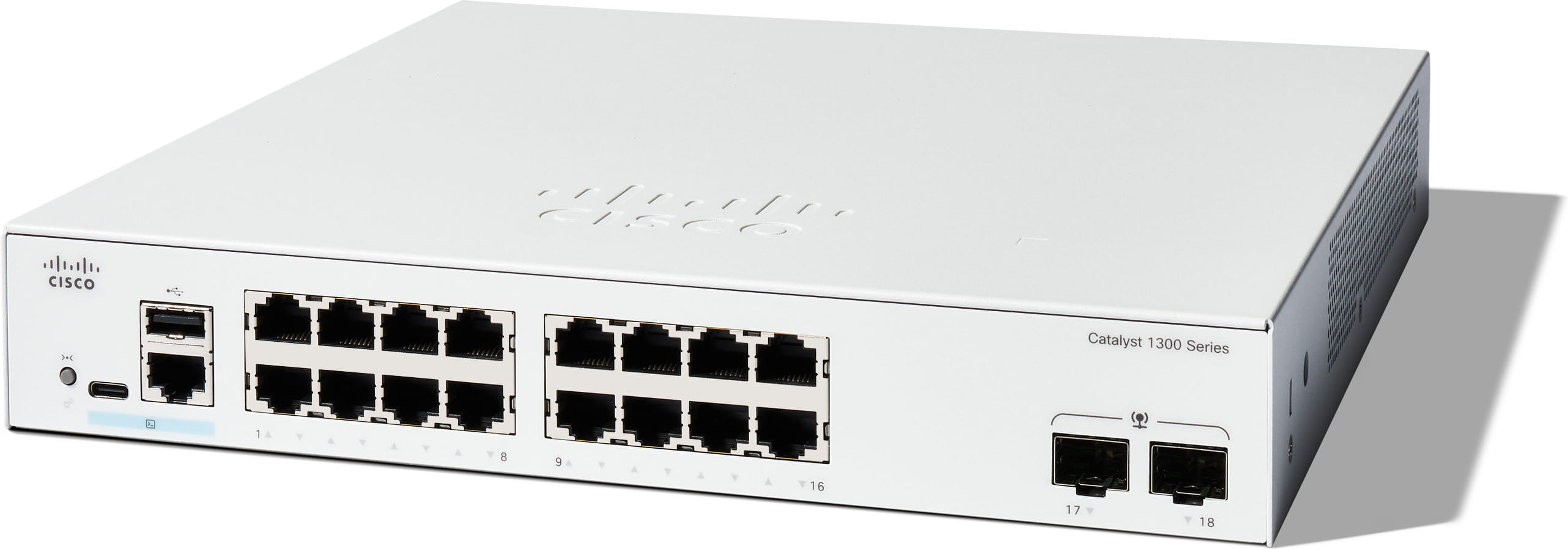
Cisco Catalyst 9300 24-port PoE+ Switch, Network Essentials (C9300-24P-E)
- Manufacturer identifier
- C9300-24P-E
- Variant
- 24-port 1GbE PoE+; modular uplinks; Network Essentials
- Region
- US
- Verified
- Official source
- Manufacturer verification
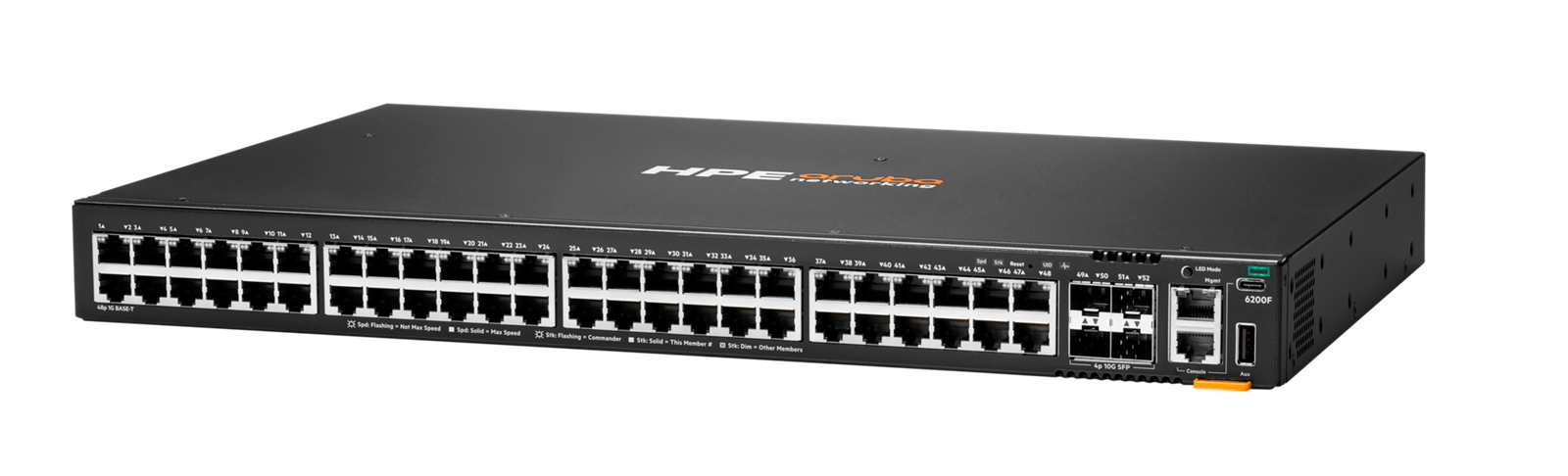
HPE Aruba Networking CX 6300F 24-port 1GbE Class 4 PoE and 4-port SFP56 Switch (JL666A)
- Manufacturer identifier
- JL666A
- Variant
- 24-port 1GbE Class 4 PoE; four 1/10/25/50G SFP56 uplinks; fixed model
- Region
- US
- Verified
- Official source
- Manufacturer verification
Equal access density makes the surrounding architecture decisive
C9300-24P-E and JL666A both serve a conventional 24-port gigabit PoE+ access layer. Neither exact model provides the multigigabit access or higher PoE classes available on other members of its family.
With that baseline aligned, the comparison becomes more useful. The question is how traffic leaves the closet, how the switches relate to other members and what happens when a component needs service. Those choices have more bearing on the operating result than simply comparing the largest switching-capacity number listed for each family.
| Decision | C9300-24P-E | CX 6300F JL666A |
|---|---|---|
| Access | 24 gigabit PoE+ | 24 gigabit PoE+ |
| Uplinks | Optional compatible module | Four built-in SFP56 positions |
| Data stack | Dedicated rear connections | Supported front interfaces allocated to VSF |
| Power service | Replaceable supplies; StackPower supported | Fixed supply and fans |
| Starting PoE budget | 445W with default 715W AC supply | 370W published model budget |
Cisco separates uplink selection from the base chassis
The C9300 requires a compatible uplink module. JL666A has four SFP56 positions built into its fixed configuration, with the documented 50G mode tied to supported DAC arrangements. The Cisco’s modularity can accommodate a later uplink change; the Aruba provides its interface positions from the start.
Stacking changes the comparison further. Cisco uses dedicated rear data-stack connections, while Aruba VSF allocates front-panel interfaces. An Aruba design using some of those positions for VSF has fewer left for ordinary external links. The relevant comparison is the completed topology after stacking and uplinks have been assigned, including its remaining paths after a link failure.
The F suffix makes power and repair a different proposition
C9300 supports replaceable supplies and a separate StackPower arrangement. JL666A has fixed power and fans. Its published PoE budget is 370W; the Cisco’s default 715W supply provides 445W for PoE, before considering other supported configurations.
Those facts favor different service plans. The Cisco can support a component-level repair and a designed power pool. The fixed Aruba can be reasonable where a whole-switch spare is available and replacement is operationally straightforward. A fair price comparison therefore includes the supplies, stack hardware and spares the organization actually intends to use. Empty redundancy slots or an unpurchased spare are not equivalent to an installed resilience arrangement.
Operator reports point to workflow, not a universal winner
C9300 administrators have reported both difficult and routine upgrades on different historical software builds. Early CX administrators also separated their experience of the local CLI from frustrations with Central switch-management workflows. These accounts do not form a controlled head-to-head test, but they do show why hardware and management experience must be evaluated separately.
Cartennas would weight the team’s intended configuration, monitoring and recovery process heavily. An existing Cisco or AOS-CX operating practice can reduce migration effort, provided the exact features and licenses fit the design. The winning system is the one whose hardware service model and operating procedures match the campus, rather than the one with the more enthusiastic isolated review.
Onsite installation support
Need help deploying the technology you select?
Cartennas provides onsite installation, replacement, rack mounting, cabling, and Smart Hands support for business network equipment across the United States.
Request Installation SupportCartennas assessment
Choose C9300-24P-E when modular uplinks, replaceable supplies or StackPower serve a defined campus requirement. Choose JL666A when its fixed service model, front-port VSF and AOS-CX workflow fit the estate. If replaceable supplies are required on both sides, the fair Aruba comparison is a suitable 6300M configuration.
Cartennas analysis of manufacturer specifications, applicable technical documentation and available firsthand operating evidence. Review methodology. Cartennas provides product procurement and onsite services. Product review terms.
Official manufacturer information
Confirm the exact model, specifications, licensing, warranty, and support terms directly with the manufacturer.
- Cisco: Catalyst 9300 hardware overview
- Cisco: Catalyst 9300 series data sheet
- Cisco: Catalyst 9300 StackWise system architecture
- Cisco: Configure and troubleshoot StackPower
- Cisco: Recommended releases for Catalyst platforms
- HPE Aruba Networking: CX 6300 QuickSpecs
- HPE Aruba Networking: AOS-CX 10.16 VSF connection topology
Product information was checked on September 5, 2026. Specifications, licensing, warranty, availability, and pricing can change.