Product identity
Manufacturer SKU, MPN, and model information
Use the manufacturer’s SKU, MPN, model identifier, or configuration code to match the exact equipment and variant.
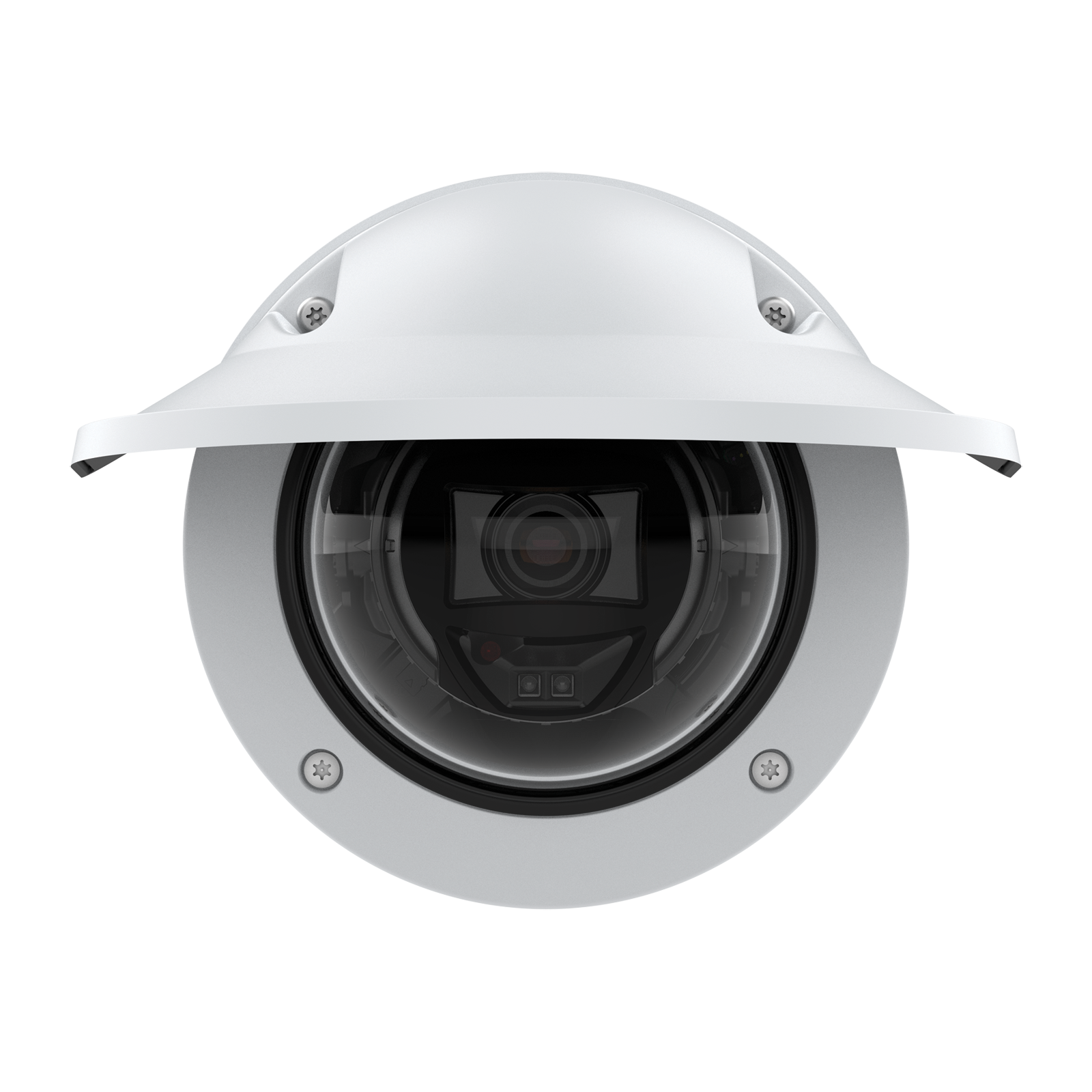
AXIS P3265-LVE Dome Camera
- Manufacturer identifier
- 02328-001
- Variant
- AXIS P3265-LVE 9 mm
- Region
- US
- Verified
- Official source
- Manufacturer verification
- Manufacturer identifier
- 02333-001
- Variant
- AXIS P3265-LVE 22 mm
- Region
- US
- Verified
- Official source
- Manufacturer verification
Hanwha Vision QNV-C8083R
- Manufacturer identifier
- QNV-C8083R
- Variant
- 5 MP IR vandal dome camera with varifocal lens
- Region
- US
- Verified
- Official source
- Manufacturer verification
Framing is the first meaningful comparison
The Hanwha provides more pixels for its selected view. The Axis telephoto variant can concentrate its image on a much narrower area. A comparison that ignores those lens differences can recommend the wrong camera even if every resolution figure is correct.
Start with the event that must be understood: an overview, a person at an entrance or activity farther from the mounting point. One broad view may not provide both context and the subject detail required for an incident.
| Question | AXIS P3265-LVE | Hanwha QNV-C8083R |
|---|---|---|
| Maximum image resolution | 1920 × 1080 | 5 MP |
| Lens options | 3.4–8.9 mm or 9–22 mm | 3.2–10.2 mm motorized varifocal |
| Horizontal view | 100°–36° or 35°–15° | 95°–29° |
| Lifecycle consideration | Replaced in lineup; support through December 2031 | Evaluate the current exact-model offering |
| Evidence task | Match the selected lens to the subject | Match higher pixel count to useful scene detail |
Low-light claims need the same test conditions
Both manufacturers describe imaging features for difficult light and on-device object analysis. Those capabilities can be useful, but feature names and minimum-illumination figures are not a matched test of moving subjects.
Exposure, subject motion, the selected field of view and the lighting available at the site all affect the result. A static scene that looks bright can still produce an indistinct face during movement.
Cartennas would compare recorded clips from the intended position with the same practical task. The evidence available for this review does not support declaring either camera universally better at night. The correct winner is the view that preserves the required detail under the site's operating conditions.
Analytics should improve retrieval of useful footage
Hanwha documents AI object functions on the QNV-C8083R, while Axis supplies its own object-analytics environment. The operational value depends on which events reach the recording platform and how easily an operator can find them.
A detection is useful when it directs attention to relevant evidence. It does not add detail to the underlying image or establish what happened outside the field of view.
Test the intended event and the operator's search path together. A camera can produce excellent local detections while the deployed recording integration exposes only basic video. That would leave part of the purchase value unavailable to the people reviewing incidents.
The Axis lifecycle makes continuity a separate buying case
Axis identifies newer replacement models and lists P3265-LVE support through December 31, 2031. Maintaining a supported installed fleet is therefore different from choosing this camera as a standard for an entirely new deployment.
Continuity can have value when the existing mounts, settings, spares and recording integration are well understood. A new project should compare the current replacements rather than assume the older model is the best starting point because it remains obtainable.
A historical P3265-LVE integration report also showed that a new camera could precede full support in a third-party recorder. That was a release-time issue, not a current incompatibility finding. Its relevance is the need to verify the exact current integration.
Which would we select?
Shortlist the QNV-C8083R when its higher-resolution view and supported event integration fit the site. Shortlist the selected Axis variant when its framing or continuity with an existing deployment provides a specific benefit.
For a new Axis-based fleet, compare the named replacements before deciding that P3265-LVE continuity is valuable. For either manufacturer, include mounts, recording entitlements, storage and the required support arrangement in the delivered design.
Cartennas would make the final recommendation from a scene test and a complete incident-retrieval exercise. Resolution and brand preference can inform the shortlist, but the recorded evidence must settle the choice.
Onsite installation support
Need help deploying the technology you select?
Cartennas provides onsite installation, replacement, mounting, cabling, and Smart Hands support for business surveillance and access-control equipment across the United States.
Request Installation SupportCartennas assessment
The Hanwha is a strong candidate for its higher-resolution varifocal view; the Axis can make sense for a specific telephoto or installed-base requirement. Prove the recorded scene and integration, and account for the Axis lifecycle before new procurement.
Cartennas comparison of exact configurations, manufacturer documentation and available firsthand evidence; unmatched tests are not treated as a controlled ranking. Review methodology. Cartennas provides product procurement and onsite services. Product review terms.
Official manufacturer information
Confirm the exact model, specifications, licensing, warranty, and support terms directly with the manufacturer.
- Axis Communications: P3265-LVE lifecycle and support
- Axis Communications: P3265-LVE datasheet
- Axis Communications: P3265-LVE operating manual
- Hanwha Vision: QNV-C8083R product specifications
Product information was checked on September 5, 2026. Specifications, licensing, warranty, availability, and pricing can change.