Product identity
Manufacturer SKU, MPN, and model information
Use the manufacturer’s SKU, MPN, model identifier, or configuration code to match the exact equipment and variant.
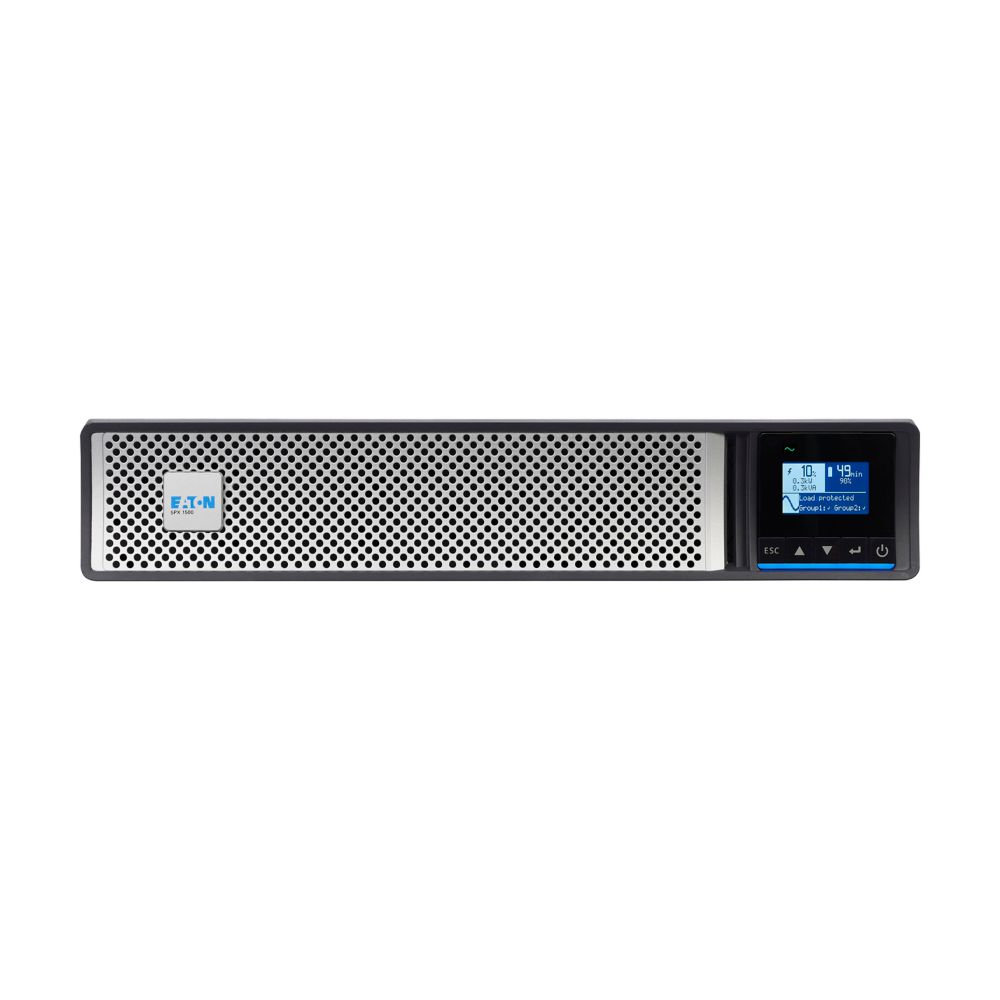
Eaton 5PX1500RTG2
- Manufacturer identifier
- 5PX1500RTG2
- Variant
- Eaton 5PX G2, 2U rack/tower, 1440 VA/1440 W, 120 V
- Region
- US
- Verified
- Official source
- Manufacturer verification
The output rating is a real comparison point
Eaton specifies the 5PX1500RTG2 at 1440 VA and 1440 W, with a NEMA 5-15P input and eight 5-15R outputs. Its 2U rack/tower format is different from a desktop-only UPS. The base RTG2 model should also be distinguished from the RTNG2 network-card bundle.
The practical advantage appears when comparing loads in watts. A rack drawing 1100 W would exceed a 1000 W UPS rating even if both products are described as 1500-class devices. It falls below this Eaton's stated output limit, although a good design still needs operating headroom and a measured runtime assessment.
That does not make the highest watt rating the automatic winner. A lightly loaded communications rack may value battery duration, serviceability and alert integration more than additional inverter capacity. The useful comparison begins with what the rack must keep doing during a power event.
Battery expansion solves a different problem from capacity
The 5PX1500RTG2 supports up to four 5PXEBM48RTG2 external battery modules. The UPS also has a user-replaceable battery and Eaton's ABM charging system. These features provide a documented path for extending service time and maintaining the battery system.
Adding an external module increases available stored energy; it does not raise the UPS's maximum supported output. A rack that has outgrown 1440 W needs a capacity change, while a rack that fits the output rating but needs more minutes may benefit from battery expansion.
Plan that expansion as installed infrastructure. Each module occupies space and adds handling weight, connections and future replacement work. A longer runtime also changes the shutdown decision: the business may intend to ride through a short interruption, wait for a generator or shut down in a controlled sequence. The extra battery should serve one of those requirements.
The noise evidence needs the charging context
Eaton's technical document describes fan-off operation when the unit is fully charged, in normal line mode and below 30 percent load. A firsthand a published report evaluation of the smaller 5PX1000RTG2 found the second-generation family's lower fan modes useful. That supports the design direction, but it is not an acoustic measurement of this 1440 W unit.
An owner of the closely related 5PX1500RTNG2 network bundle reported that the fans initially continued despite a full-charge display, then eventually stopped after additional charging time. The same discussion described fan activity returning periodically. These are individual observations, not a guaranteed timeline for every installation.
The conclusion is narrower and more useful than calling the UPS silent: it can become quiet under defined conditions, and charging behavior matters. For a rack next to occupied desks, evaluate initial charging, battery operation and recharge after an event. A demonstration performed only in a settled low-load state misses the periods employees may find most disruptive.
Remote management should survive the event it reports
The network bundle can simplify ordering for a managed site; the base model requires the appropriate communications option if the design calls for it. Specify that relationship before comparing quotes, since a lower bare-unit price may exclude a function the support team needs.
Monitoring, shutdown and restart remain separate responsibilities. A management card can expose UPS status, but protected hosts still need the intended shutdown integration. The switch and route carrying those signals also need to remain available long enough for the sequence to finish.
For a branch rack, we would group the protected load by dependency: communications needed for management, storage needed by hosts, and applications that must stop before either disappears. That is the operating logic behind battery sizing. Simply connecting every available outlet can leave a nonessential device consuming the reserve needed by the system that matters most.
Our recommendation
The 5PX1500RTG2 is a strong candidate when an edge rack needs useful watt headroom and a supported way to buy more runtime later. Its battery expansion and rack form factor can justify a higher installed cost than a simpler tower UPS.
We would compare the completed bill of materials, including the management option and any external modules, against the required outage behavior. Where extended runtime is unnecessary and the load is modest, its expansion capability may remain unused. Where the rack is likely to grow, establishing that path at purchase can avoid replacing an otherwise capable UPS.
A commissioning record should capture the actual rack load, noise during charging, shutdown completion and recovery after utility returns. Those observations turn a promising specification into an operating standard for the next site.
Onsite installation support
Need help installing or replacing the 5PX1500RTG2?
Cartennas provides onsite installation, replacement, rack mounting, cabling, and Smart Hands support for business power and infrastructure equipment across the United States.
Request Installation SupportCartennas assessment
The 5PX1500RTG2 is particularly attractive for branch racks that need watt capacity and planned runtime growth. Match the network bundle and battery modules to that requirement, and assess noise across the charging cycle.
Cartennas evaluation of exact-model manufacturer data, management requirements and the scope of available firsthand evidence. Review methodology. Cartennas provides product procurement and onsite services. Product review terms.
Official manufacturer information
Confirm the exact model, specifications, licensing, warranty, and support terms directly with the manufacturer.
- Eaton: 5PX1500RTG2 specifications
- Eaton: 5PX1500RTNG2 network bundle
- Eaton: 5PX G2 North American technical specifications
Product information was checked on September 5, 2026. Specifications, licensing, warranty, availability, and pricing can change.