Product identity
Manufacturer SKU, MPN, and model information
Use the manufacturer’s SKU, MPN, model identifier, or configuration code to match the exact equipment and variant.
Synology DiskStation DS1823xs+
- Manufacturer identifier
- DS1823xs+
- Variant
- Synology DiskStation DS1823xs+
- Region
- US
- Verified
- Official source
- Manufacturer verification
This is a file-service platform with an operating model
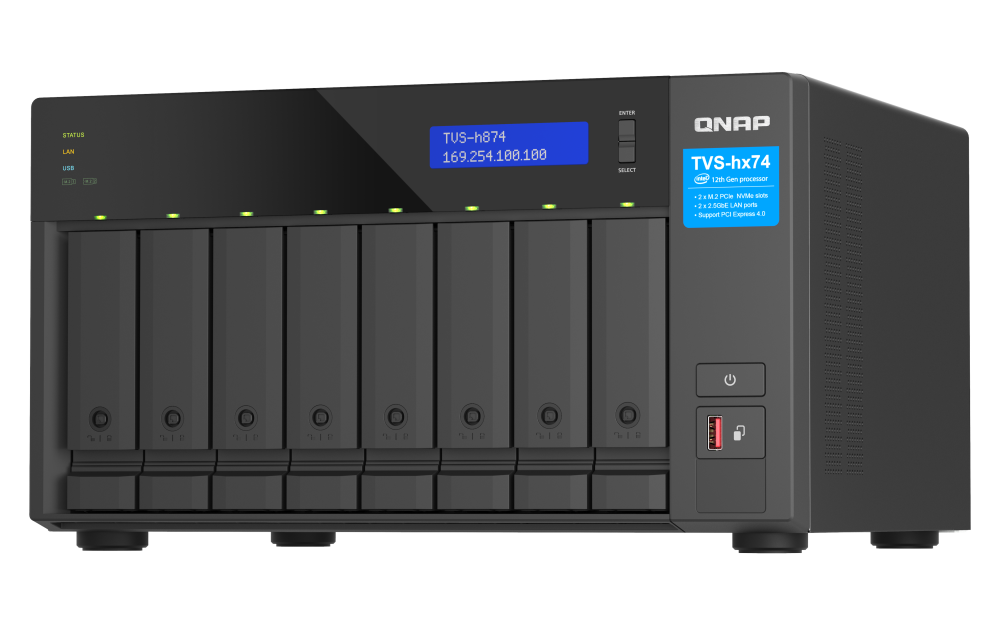
The DS1823xs+ combines eight drive bays with an AMD Ryzen V1780B processor, ECC DDR4 memory and built-in 10GbE. It also has two Gigabit data ports, two M.2 slots and a separate management connection. Synology supports expansion through compatible DX517 units.
The value proposition is broader than raw disk capacity. An organization choosing this model is also selecting the DSM administration environment, its supported components and its approach to file services and protection.
That can be attractive for a team that wants consistent administration across sites. It is less attractive if the purchase assumes unrestricted use of whichever drives happen to be cheapest. The storage design and support expectations need to match the product class.
The independent results explain why workload matters
A hands-on test populated the NAS with four 4 TB Synology drives and used a 10GbE connection. Synthetic sequential results reached approximately 9.3 Gbit/s for reads and 9.2 Gbit/s for writes, showing that the tested setup could make good use of a single 10GbE link.
Application-style transfers were different. A 25 GB file copied at about 5.7 Gbit/s, while a 22.4 GB collection containing roughly 10,500 small files backed up at around 2.7 Gbit/s. The tested encrypted copy was slower again.
The lesson is not that one result invalidates another. Each describes a different operation. A department moving large video files and one backing up many small documents can experience the same NAS very differently. Cartennas would size around the actual file mix and protection settings, rather than translate a sequential benchmark directly into a backup window.
The XS+ compatibility decision should be made before purchase
Synology maintains model-specific compatibility information, and its drive-policy changes distinguish between product classes. Announcements concerning newer Plus-series products should not be treated as a blanket change to the DS1823xs+ support position.
The appropriate buying question is therefore specific: which drive and firmware combinations are supported in this model under the intended DSM version, and what support is available if a different combination is used?
This affects both initial cost and replacement planning. A support team that keeps a generic pool of spare disks may need a different arrangement for this NAS. That is an operating-cost consideration, not merely a procurement footnote. Confirming it before standardization is more useful than discovering the boundary during a degraded-array incident.
Separate management helps, but the chassis still has limits
The dedicated management connection provides an out-of-band path for functions such as restarting the system and obtaining diagnostic information when normal DSM access is unavailable. That can reduce dependence on a person standing beside the enclosure.
It does not create a second storage system. The NAS still has shared components and dependencies, including its location and network path. ECC memory, redundant disk arrangements and local snapshots each address particular failure modes; none is a complete disaster-recovery design.
For a branch deployment, Cartennas would pair the local file-service role with an independent, recoverable copy and a defined way to restore the required permissions and applications. The management connection should also be reachable through an appropriately restricted administrative path.
Where the DS1823xs+ earns its place
The strongest fit is an organization that wants the Synology operating environment, a supported eight-bay configuration and substantial network throughput without assembling a separate storage server. Built-in 10GbE and management access reduce some integration decisions.
The weaker fit is a purchase justified solely by maximum published throughput or by an assumption that every drive policy applies equally across the product range. Expansion capacity also deserves a careful failure-domain assessment when the same NAS remains responsible for the larger pool.
Cartennas recommends evaluating this model with a representative file set, the intended encryption and protection settings, and a confirmed component-support plan. That combination reveals whether the platform delivers the required service at an acceptable operating cost.
Onsite installation support
Need help installing or replacing the DiskStation DS1823xs+?
Cartennas provides onsite installation, replacement, rack mounting, cabling, and Smart Hands support for business servers and storage equipment across the United States.
Request Installation SupportCartennas assessment
The DS1823xs+ is a compelling managed file-service option when its software environment and supported-component model fit the organization. Use practical workload tests and an explicit recovery design to decide whether its throughput and operating cost justify the choice.
Cartennas synthesis of model-specific manufacturer documentation and independent hands-on evidence, with configuration limits and operational implications evaluated separately. Review methodology. Cartennas provides product procurement and onsite services. Product review terms.
Official manufacturer information
Confirm the exact model, specifications, licensing, warranty, and support terms directly with the manufacturer.
- Synology: DiskStation DS1823xs+ product and specifications
- Synology: DS1823xs+ drive compatibility list
- Synology: Drive compatibility policies
Product information was checked on September 5, 2026. Specifications, licensing, warranty, availability, and pricing can change.